
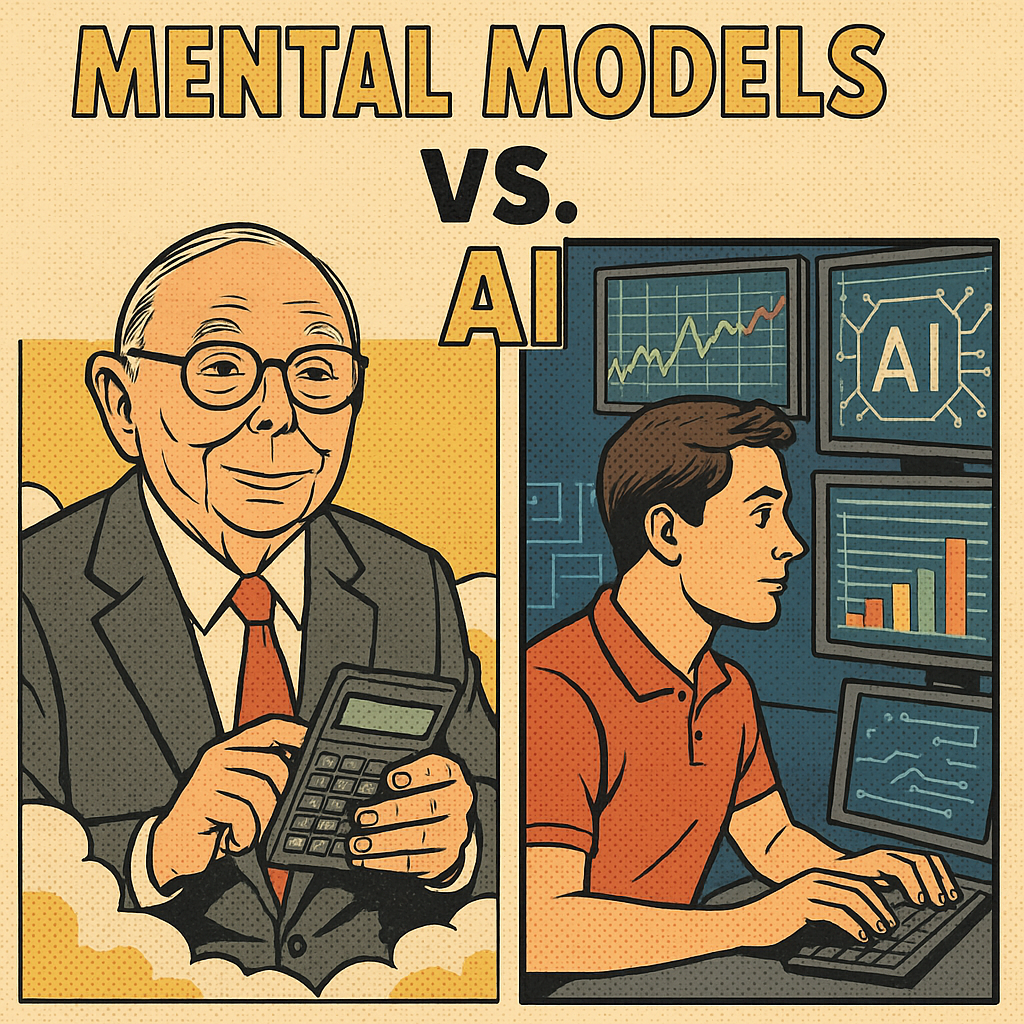
Tuesday afternoon.
My screen’s a blur of tanker rates, dairy prices, IoT adoption curves, and chip exports.
No, I haven’t become a polymath overnight.
I’ve just got caffeine—and AI.
Between GPT-4, Perplexity, Gemini, Grok, and DeepSeek, the entire modern finance stack is a prompt away. Sector summaries, forensic red flags, management tone shifts—delivered in seconds.
No analyst calls. No data rooms. Just pure velocity.
Sounds like every investor’s dream, right?
But here’s the nagging question:
Has all this made us better investors…
or just better at reacting?
More Info, Same Mistakes
We believed more access would mean more edge.
More data → faster insights → better returns.
It didn’t pan out that way.
Barber & Odean (2000) showed that overly active individual investors underperformed the market by 6% annually—not due to lack of information, but because of overconfidence and poor decision hygiene.
Fast forward to 2017: a study of over €300 million in trades on a European social investing platform found that users disproportionately copied bullish posts from “influential” accounts. Not because of sound analysis—but because those posts sounded more confident.
Trading activity surged.
Returns? Not so much.
The lesson: We’re wired to respond to confidence, not accuracy—and more data often amplifies noise, not signal.
The Raju Analogy
My grandfather’s driver, Raju, was a navigation wizard. Knew every street in Delhi. Parked like a surgeon. But, he could not read … not even a word.
And then cars changed. GPS became standard. Screens replaced dials. Roads shifted, and signage emerged. Raju was left behind—not because he forgot how to drive, but because the system evolved.
That’s most investors today.
If you don’t use AI, you’re not even in the game.
But if you rely only on AI, you’re just Raju in a Tesla he can’t operate.
What AI Can Actually Do (and I Use It Daily)
Used right, AI is a monster productivity boost. It can:
- 🧾 Summarize filings, concalls, and investor decks
- 📊 Extract and compare financials across companies
- 📉 Run DCFs, Piotroski Scores, Z-Scores, capital allocation trends
- 📈 Highlight tone shifts in management language
- 🔍 Spot inconsistencies across filings, news, and analyst views
- 🧠 Surface mental models and apply industry frameworks
- 📋 Draft memos, dashboards, kill-list summaries
It compresses research cycles from hours to minutes.
But here’s the part no one talks about…
Same Prompt. Same Source. Different AI. Different Result.
Give the same stock and same source material to GPT-4, Grok, and Gemini.
Ask the same buy/sell/hold question.
You’ll likely get different answers. And surely, meaningfully varying convictions.
Why?
Because these models don’t invest.
They don’t weigh trade-offs.
They don’t know your goals or the rules of your game.
They’re trained to generate—not to judge.
You don’t need better prompts.
You need better questions grounded in first principles.
Instead of asking, “Should I buy this stock?”, the serious investor asks:
- What’s the downside in this scenario?
- What assumptions drive this growth?
- How does this behave in a flat market?
- Is the promoter doubling down—or quietly exiting?
This is where mental models win.
They help you compress information into fast, high-quality decisions—like whether a stock even belongs on your kill list.
Not a full memo. Just: Look deeper? Or move on?
Where AI Can’t Help
It doesn’t feel drawdowns.
It hasn’t misjudged a CEO.
It doesn’t know what it’s like to do nothing while the market’s running laps around you.
Mental models aren’t just frameworks—they’re filters forged by:
- Pattern recognition
- Scar tissue
- Time in the game
- Deep reflection
- Restraint
AI can quote Buffett.
It can’t become him.
The Real Edge: Human + Machine
The future belongs to investors who:
- Use AI to scale and speed up research
- Apply judgment to filter and prioritize
- Stay anchored in first-principles thinking
- Know when to ask better questions—and when to stop asking
AI is the baseline.
Mental models are still the moat.
Final Takeaway
AI won’t replace good investors.
But good investors who use AI will replace those who don’t evolve.
Use AI to think faster.
Use mental models to think better.
But always invest with your own mind—not just the machine.
Let me know how you are using AI in your investment process—and where you still rely on instinct. Let’s trade notes – [email protected]