
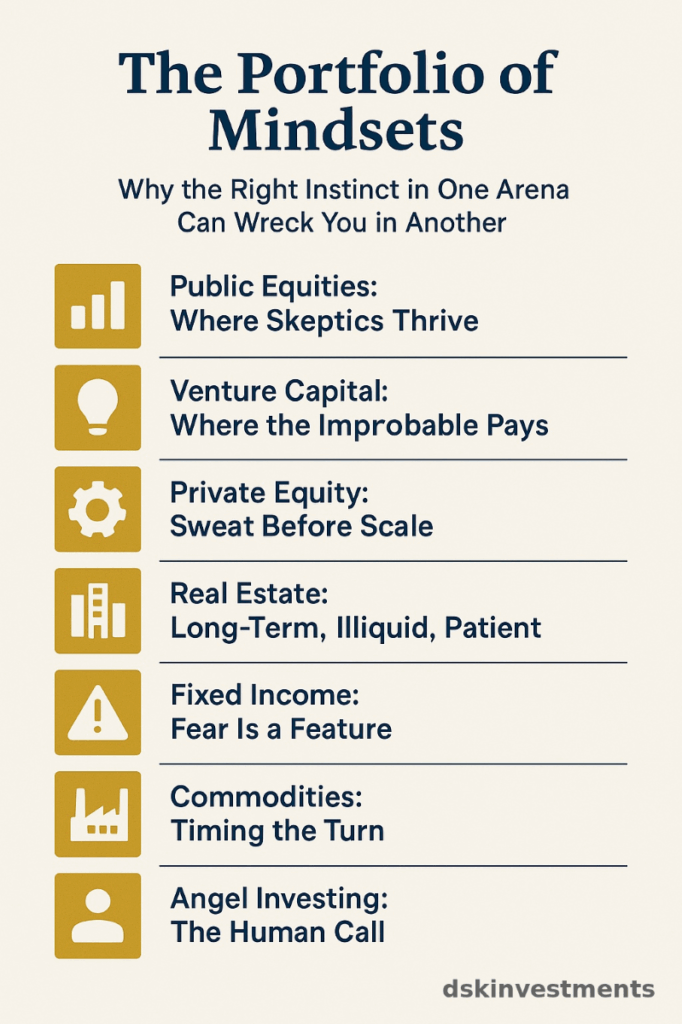
In the world of investing, a persistent myth endures: that of the all-weather fund manager—one who can master public markets, venture capital, real estate, debt, and more, all with a singular, transferable mindset.
Reality doesn’t work that way.
The hard truth is this: great investing is domain specific. Each asset class is governed by its own rules, rhythms, and risk structures. The temperament that wins in one arena often becomes a liability in another.
Managing capital successfully across asset classes requires more than asset allocation. It demands a portfolio of mindsets—each tailored to the psychological demands of the specific game being played.
The Map: Seven Distinct Mindsets, Seven Different Games
| Asset Class | Winning Mindset | What It Rewards | When It Misfires |
| Public Equities | Disciplined Scepticism | Valuation awareness, risk-reward calibration | Paralysis when facing early-stage innovation |
| Venture Capital | Conviction in Outliers | Power-law investing, belief in non-consensus bets | Overexposure to hype in public markets |
| Private Equity | Operational Control | Execution, leverage, and cost optimization | Strangles creativity in early-stage businesses |
| Real Estate | Patience with Leverage | Timing cycles, managing illiquidity | Confuses poor assets with long-term holds. |
| Fixed Income | Asymmetric Risk Aversion | Downside protection, capital preservation | Avoids necessary risk. Loses out to inflation over time. |
| Commodities | Macro-Cycle Discipline | Timing supply-demand extremes | Misreads structural growth trends as cyclical peaks |
| Angel Investing | Betting on the Founder | Belief in people over spreadsheets | Misplaced trust in charismatic CEOs with poor business fundamentals |
#dskinvestments
1. Public Equities: Where Skeptics Thrive
In liquid markets, information is democratized. The winning edge often comes from temperament—particularly, the ability to stay rational when the world isn’t. This is where disciplined skepticism pays. Investors must discount management optimism, resist market euphoria, and prize valuation discipline over narrative momentum.
📌 Example: Buffett’s caution in the late 1990s seemed out of touch, but spared him from the dot-com collapse.
2. Venture Capital: Where the Improbable Pays
The best venture bets sound irrational at the outset. Venture capital rewards conviction in outliers—a belief in non-consensus ideas with exponential upside. The game is power-law dominated: a few winners more than make up for the many write-offs.
📌 Example: Airbnb looked ridiculous on paper. Sequoia saw it as inevitable.
Apply this mindset to listed equities, and the same optimism leads to chasing “next-gen disruptors” at 80x sales.
3. Private Equity: Sweat Before Scale
Private equity isn’t about vision—it’s about execution. It’s a slow grind of value extraction, not upside chasing. The winning mindset is operational control, often powered by financial engineering and margin discipline.
📌 Example: KKR’s acquisition of RJR Nabisco was a classic PE play—built on leverage and cash flow, not disruption.
But apply this control-heavy lens to a fragile startup, and you smother the very chaos that fuels innovation.
4. Real Estate: Long-Term, Illiquid, Patient
Real estate plays out over decades. Cycles matter. Leverage must be timed. Here, the mindset is patience with illiquidity. It’s a game for those who can tolerate short-term volatility without panic.
📌 Example: Developers who held prime properties through downturns saw recoveries. Those who overbuilt didn’t.
Take this mindset to public markets, and it turns into dead capital—holding a sinking stock long after the thesis broke.
5. Fixed Income: Fear Is a Feature
In bonds, your upside is known. Your downside can be catastrophic. The correct mindset is asymmetric risk aversion—an obsession with default risk, structural subordination, and worst-case outcomes.
📌 Example: PIMCO’s credit team spotted the risks in AAA-rated mortgage paper in 2007. Others trusted the labels.
Apply this mindset across the portfolio, and you end up under-allocated to growth, trailing inflation.
6. Commodities: Timing the Turn
Commodities don’t care for valuations or earnings. They are driven by macro cycles, exogenous shocks, and mean reversion. Success requires humility, timing, and exit discipline.
📌 Example: Traders who entered the metals rally in the early 2000s on China’s boom created generational wealth. Those who stayed too long gave it back.
Apply this lens to tech or structural themes, and you’ll sell your compounders far too early.
7. Angel Investing: The Human Call
At seed stage, there’s no traction. Just people. Angel investing rewards intuitive judgment about founders—resilience, clarity, and vision trump financial metrics.
📌 Example: The earliest investors in Uber didn’t see a taxi app. They saw Travis Kalanick’s aggression as an unfair advantage.
Try this mindset with public CEOs, and you risk mistaking charisma for competence—just ask anyone who held WeWork past the prospectus.
Closing Thought
In bull markets, everyone wants to sell you the next thing. A public equity fund that’s ridden a wave suddenly launches a venture fund. The pitch? Past returns, repackaged as foresight.
Hear them out. But don’t confuse domain success with universal genius.
Managing wealth is like being a good General Counsel. You don’t argue the case yourself. You know which lawyer to pick for which courtroom. Venture capital, public equities, debt—they’re different games with different rules.
Tendulkar wasn’t picked as Team India’s goalkeeper. Messi’s not making the IPL. Greatness is role-specific.
Same goes for money managers.