
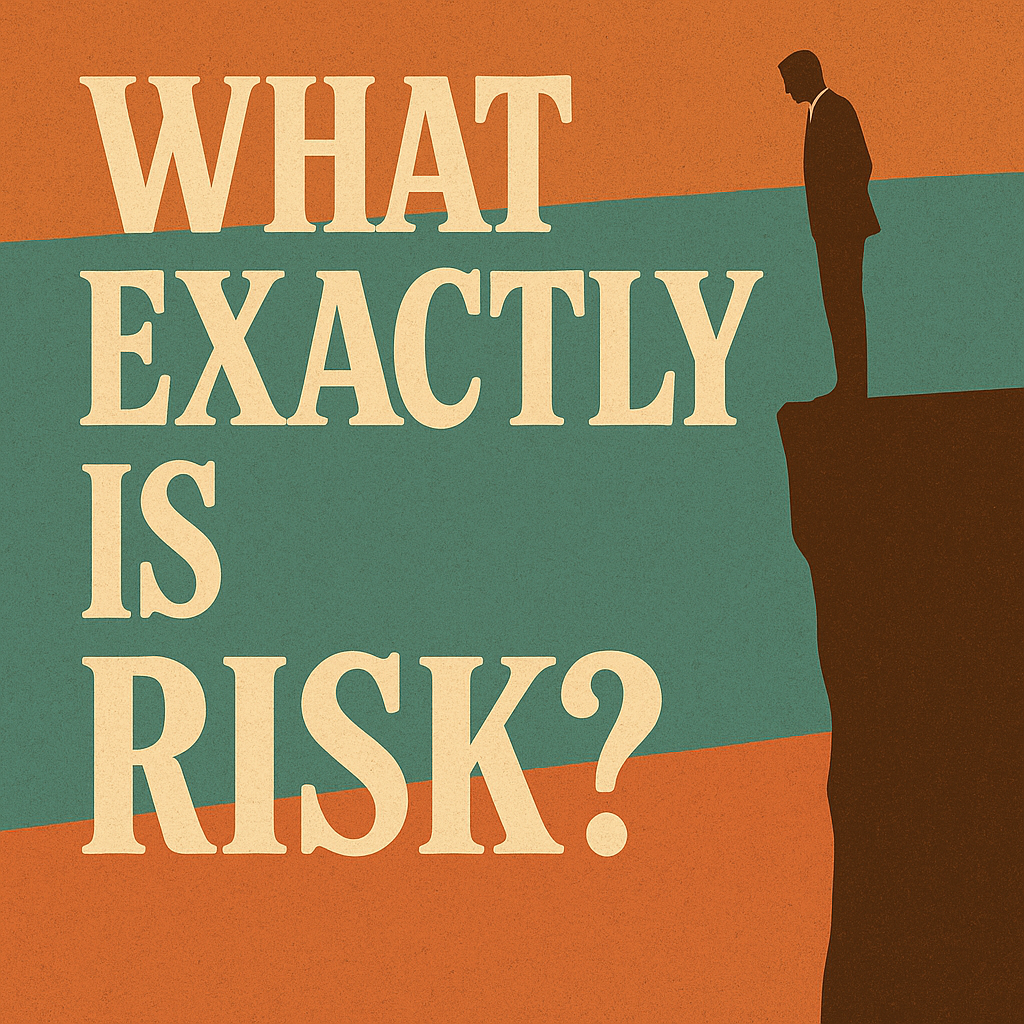
Every investor talks about risk. Few understand it. Fewer still admit how it feels.
We treat risk as one enemy—volatility, measured with beta, standard deviation and variance. Neat for a textbook. Useless in a drawdown.
In real life, risk lives in your bloodstream. It’s that sick feeling when your portfolio is down 25%. It’s panic-selling blue chips at the bottom, then never buying back.
This gap between what’s measured and what’s experienced is Risk Drift.
It is the silent disconnect between how risk is measured and how risk is experienced. While institutions weather these storms through process and scale, individuals are human first. They stumble on psychology.
Risk is not one monster. It is a four-headed beast. Two of these risks are external—they happen to you. The other two are internal—they are what you do to yourself.
1️⃣ The Cliff 🪨- Permanent Loss of Capital
The risk everyone fears: a company blowing up, leverage gone wrong, fraud. It’s also what happens when fear convinces you to turn a temporary drawdown into a permanent exit.
👉 Example: A retired couple put 30% of their savings in “secured” 16% NBFC bonds. When the firm collapsed, they lost ₹1.2 crore. They didn’t need high returns. They needed certainty.
📊 Context: In India, hundreds of unregulated chit funds and NBFCs collapsed between 2010–2020, wiping out thousands of crores in household savings.
The Shield: Ringfence what you can’t afford to lose—3–5 years of living costs in safe, liquid assets. Return of capital beats return on capital.
2️⃣ The Silent Thief 🕵️- Inadequate Returns
This one is invisible, but deadly. It robs through inflation and tax while you sleep.
👉 Example: A 40-year-old IT professional proudly held a “risk-free” portfolio of fixed deposits. Post-tax yield: 5%. Inflation: 6%. Net return: negative. His “safety” guaranteed erosion of wealth.
📊 Context: Over the past 15 years, FD returns (after tax) have trailed CPI inflation in 9 of those years. Investors who parked in deposits saw their purchasing power shrink even as they felt “safe.”
The Shield: Do the math. What return do you need to hit your goals? Build a portfolio for that, not just for comfort. Low volatility ≠ low risk.
3️⃣💀 The Ghost – Missed Opportunities
This risk is a ghost—the compounding you never see, but whose absence will haunt your future. It is the wealth vaporized by hesitation.
👉 Example: In March 2020, one investor held her ₹18 lakh portfolio through the chaos—it was worth ₹27 lakh a year later. Another liquidated ₹20 lakh into “safe” cash and missed an ₹8 lakh rebound. Comfort cost him more than fear.
📊 Context: In 2020, Indian mutual funds saw record net outflows of ₹13,000+ crore during the crash, yet the Nifty recovered over 80% within the next 12 months. Most investors missed the rebound because they sought comfort, not compounding.
The Shield: Automate courage—SIPs, rebalancing, and a “dry powder” reserve. Structure forces you to invest when others freeze.
4️⃣🧠 The Saboteur – Behavioral Risk
This is the internal risk that undermines all the others. It’s not about what the market does; it’s about how you respond—both in fear and in greed. Some investors can’t stomach a 25% drawdown and sell at the bottom. Others mistake a bull run for genius and take reckless bets. In both cases, the market isn’t the problem. The mind is. Volatility isn’t risk. Your reaction to it is.
👉 Example: In 2021, a young investor mistook a bull run for skill. By 2022, his overconfidence pushed him into penny stocks and leveraged F&O trades. Half his gains evaporated—not because the market collapsed, but because he couldn’t manage himself.
📊 Context: In FY23, NSE data showed 9 out of 10 retail F&O traders lost money, with an average annual loss of ₹1.1 lakh. Despite India’s bull market, most retail participation destroyed wealth, not created it.
The Shield: Build a “sleep-well” buffer (cash or bonds) to calm nerves. Lock core equities mentally for a decade. Add a 24-hour cooling-off rule before acting on fear or greed.
What Should You Do?
Forget generic thumb rules. Instead, conduct a personal “Risk Audit”. Write down the answer to these questions:
- What can I not afford to lose? (The Cliff)
- What return do I absolutely need? (The Thief)
- What opportunities have I missed due to fear? (The Ghost)
- When have I panicked in the past? (The Saboteur)
Design your asset allocation around your answers—not market noise, not peer pressure.
The Four Faces of Risk: A Summary
| Direct Capital Loss | Opportunity Cost | |
| External (Market-Driven) | 🪨The Cliff: Permanent Capital Loss Business failure, Fraud, Forced liquidation of quality assets | 💀The Ghost: Missed Opportunities Sitting in cash, Not deploying in crashes, Ignoring asset classes, Avoiding volatility entirely |
| Internal (Behaviour-Driven) | 🧠The Saboteur: Behavioural Risk Panic selling, FOMO, Lack of discipline, Buying high/ selling low, Chasing trends | 🕵️The Silent Thief: Inadequate Returns Safety overload, Equity avoidance, Comfort trap, Inflation ignorance |
Final Thought
Managing wealth isn’t about chasing the highest return. It’s about building freedom—the freedom to live without fear or compromise. The market won’t kill your portfolio. You will, if you don’t know which risk monster you’re facing.
The biggest risk isn’t volatility. Its pretending to be comfortable when you’re not.